Podcast Episode
May 13, 2026
Episode 3 | We Almost Left Bob in Nassau

Show Notes
What happens when 3,000 attendees get off a cruise ship, the event app loses its superpower, and one person decides Nassau is apparently a choose-your-own-adventure? This went from “fun port stop” to “please tell me Bob is back on the ship” real fast.
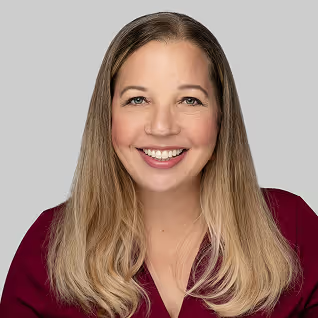
Host Jen Santos chats with Kelly Burhop, senior lead event technologist at Sound Planning Meeting and Events, on this episode of Mayhem & Method. Kelly is here to share the very specific chaos of running a large employee event across two cruise ships.
What starts as a smart, cost-saving, cohort-based event format quickly reveals one tiny problem: push notifications do not work when your attendees are off the ship, away from Wi-Fi, and wandering around Nassau like they missed the memo.
What follows is a very event-pro blend of mobile app logistics, group scheduling gymnastics, maritime check-ins, security team heroics, and the classic post-event realization that yes, you now need a contingency plan for “what if no one receives the message?”
Top Takeaways from Kelly & Jen’s convo:
- Wi-Fi is not a communication plan. It is a communication hope with a login screen.
- If attendees can wander, one of them absolutely will. Build the plan for Bob.
- A cruise ship event can be surprisingly efficient… right up until your app, your cohorts, and international port logistics all decide to test your blood pressure.
Podcast Guest
Kelly Burhop
Senior Lead, Event Technologist
Kelly Burhop is a Senior Lead of Event Technology at Sound Planning Meetings & Events with a decade of experience managing event and marketing tech stacks for a Fortune 100 tech company. She now brings that enterprise perspective to Sound Planning's clients, focusing on platform operations and governance at scale. In her free time, she writes about event technology strategy and patterns across the events industry on her Substack, The Burhopper.
Transcript
Episode Transcript
We actually did have someone wander off in Nassau, and that was kind of — it was like, oh my gosh, we almost left him.
Hey everyone. I'm Jen Santos, and this is Mayhem and Method, where event pros tell the real story of what happened and what it reveals about how events actually work. Welcome back to another episode of Mayhem and Method. Today I am here with Kelly Burhop, who is a senior lead event technologist at Sound Planning Meetings and Events. Thank you for being here, Kelly.
Yeah, thanks for having me.
I am absolutely delighted to have you here, and I love the fact that we get to work together now on a regular basis. What is your favorite onsite or hotel room comfort hack?
When I was thinking about this — I definitely pack my own pillowcase. There's something about hotel sheets that make me feel like I'm not sleeping on my own pillow. So I usually bring that. And then I've also just been bringing my own tea. Anything that they put in there is not really that great. I know I've stayed at extended stays for a while, but just having my own Bengal tea at night has been my comfort item, if you will.
I love that. The idea of a pillowcase has never occurred to me. I know people that bring their pillows — I don't really care about that — but the pillowcase idea is interesting because I have these super lightweight sheets. I live in Brazil and it's really hot here, so I need special sheets, but now I'm used to them. When I go to a hotel, I'm like, these things are itchy.
Yeah, yep.
And then I bring pre-ground cold brew and I make cold brew every night in my hotel room so I have it for the next day.
I'll have to take a note of that. I definitely hate hotel coffee. I hate hotel room coffee, and I don't like seeing the public before I've had coffee, so going down and waiting at a Starbucks line is a non-starter. So yeah, this is my newest thing — bringing the pre-ground cold brew.
Nice.
So let's get into the main part of our conversation. Just to remind you about the setup — we're going to take a couple of minutes and give a few sentence summary of how this thing ended, and then from there we'll back up into what happened. Kelly, tell me your story for today.
A few years ago there was an event where we were on a cruise ship, and one of the major things we really didn't account for was wifi when you're not on the ship, and being able to communicate with all 3,000 attendees we were supposed to be communicating with. You can imagine just having this kind of black hole every time someone went to port, and then hoping people came back.
So why didn't you have wifi or cell service or any sort of reception when you did a port stop? Why was that not a thing?
I was managing the event mobile app, and at the end of the day we told all our attendees: we're on the water, so to avoid roaming fees, everyone just switched to wifi. It was kind of the call of the team — we don't really want to pay for roaming fees, wifi should be sufficient. But then when we would land at different stops — they were on islands in The Bahamas — if you weren't close to the ship, the wifi didn't reach where we were. So we were trying to tell everyone it was time to come back to the ship, and then we realized no one was getting those push notifications because they weren't connected to the wifi to receive them.
How many port stops did you have on this trip?
Two. It was a three-day event.
Walk me through the first one. Walk me through that realization and the conversations that were had.
The first one was Royal Caribbean's main island that they own. It was essentially everyone getting on the island and having a fun day with the team. It wasn't intentionally meant to be heavy content or be glued to the mobile app — it was more like, go out, there's going to be food, bring your bathing suit, be interactive. I don't think we really realized it until I was trying to get to an activity, just helping the events team, and I was like, oh, I can't talk to anyone. I ultimately just turned my roaming on because I needed to be able to talk to the team. We then found out this wasn't just an isolated incident — everyone who didn't have wifi wasn't getting these communications. Luckily everyone was done on the island and we all got back to the ship just fine. But I don't think it dawned on us to put some sort of contingency plan in place. It was really just kind of a thought floating out there, and we didn't really plan for the next stop.
And then the next stop was Nassau.
Yeah, we were in the amphitheater. We were collecting donations and there was going to be live music and food to just hang out. And these are the two stops where both ships would be able to intermingle. So this whole time we'd had separate attendee groups, sending unique push notifications to each individual group. When we got onto the island we were like, oh, that's right — no one's getting this update to remember to bring the children's coloring books for the donation. One of the ships was kind of close by, so some people were getting it, but others weren't because they weren't on that ship and didn't have that ship's wifi. It was just one of those things — we totally accounted for communications on the ship, but didn't really account for it when we got off. We didn't think it was going to be a big deal because it's just a couple of hours off the ship. But now I know, and I'll have that on my workback schedule to plan for.
Got it. So you had two ships, which is also interesting — I hadn't heard that part. How did the wifi work between the two ships? You were running the mobile app for effectively both ships, right?
The ships themselves had a streaming function where they were connected. So we didn't need individuals communicating between ships directly, but we did have everyone in one activity feed in the mobile app so that they could talk with other people on the other ship. We really didn't see people doing that much though. A few times when we first set up the app, people were like, oh, what ship are you on? And we decided to put a little icon by their name — the blue ship is the Freedom, and the purple ship is — I can't remember the other name now. But essentially a visual way to be like, oh, Kelly's on the blue ship. That way people knew, I might not run into them on the ship, but maybe we can meet up on the islands when we stop.
We essentially purchased the standard wifi package. Have you ever been on a cruise ship before?
I have, but it was a very, very long time ago.
My brother just recently went and it was like, do we purchase the wifi package or not? So as an event team, we were like, we're going to purchase the standard wifi package. Ships don't have breakout rooms like you would at a convention center, so the whole format of the event went to small group sessions focused on account-based marketing. People were just in the restaurants, talking in groups of 10. The app helped facilitate those group conversations. It wasn't super wifi-heavy in the first place, but it was definitely used a lot on the ship as the main way for people to communicate.
That makes sense. And after I asked that question I realized — oh wait, the push notifications are still hitting the internet, going to the server, and then the server is sending them out. So that was a silly question on my part.
Oh, you're good.
Two ships, two sets of push notifications, going to the island. So you all get off for the activities — did the Royal Caribbean island even have wifi, or did you just not think to ask?
I don't think we needed it because at the end of the day, we were there to swim. It wasn't like there was a stage to talk about the company before everyone went swimming. It was meant to be recreational. It's one of those things where you balance: do we want people to be on their phones, or do we want them swimming?
That makes sense. And nobody wandered off at that one.
No, not at that island. We actually did have someone wander off in Nassau — it was like, oh my gosh, we almost left him. We told them before they got on the island: we're just here at the amphitheater, we didn't take over Nassau. That was one of the risks we had documented — maybe people don't come back. But our security team was great and they were on it and they were able to find him and get him back before the ships left port.
Holy cow. So how were you able to track whether everybody was back on the boat or not?
At the bottom of the ship, it's like going through TSA all over again. You have to bring your identification because you're essentially entering and leaving the country. I had to get a crash course on maritime travel policies for that event, but essentially everyone has to get checked back in. They have a whole manifest — Kelly Burhop came back, Jen Santos came back, but Bob did not come back, he's not checked in. So that's how they found and flagged that that person wasn't back, and we had to scramble and go look for him.
Got it. Because you're effectively leaving the country and entering it again, so you need your passport. And somehow in my head that wasn't necessary because this was a private event — which I realized is an utterly ridiculous thing to think, but that's what my brain had done. So you had told people not to wander off, and then Bob decided he was just going to go wandering off anyway.
Yeah. The port is essentially just this long dock, and we had stanchions to get people to go where they needed to go. We actually walked through part of the city — they had little huts where they're selling goods, kind of like what you'd see in Mexico with people selling blankets and things. So there were places where you could walk off in a certain direction and get into the city. We even had the band up on stage remind everyone: please don't go into the city, this is where we are staying, we didn't contract the whole city, and it's for your safety. Not that it's unsafe, but just — this is our space. And he wandered off anyway.
There's always that one person. I've been on Instagram more lately and they show those cruise runner videos all the time — boarding is at 4:30 and you see people walking back quickly, then more quickly, and then you see the cruise runners. That's what I'm envisioning now — Bob and the security team running back. But would you actually have left Bob behind? Was that an honest consideration?
I've been told that has happened before. And honestly, I don't know how he would have gotten home. Personally, I was like, oh my gosh, I need to know what time it is so I don't miss us departing. But obviously he did not care.
He did not care. On a commercial cruise — a Carnival cruise, whatever — if you miss the ship, you're on your own. You get yourself to the next port however you need to. But on a company event, I would assume the risk calculus is completely different.
Our security team — there's a dedicated security division within the company, and we always have three or four of our direct security team at our events. They always connect with local enforcement. So I would see them potentially leaving one of our security guys on the island and then figuring out how to get them back if they weren't able to find him. They're an amazing team. Any other company, I don't know if they would have done that or had that much security. But it's one of those things — we have to account for employee events and make sure employees are traveling safely. That was the vibe of the event.
That makes perfect sense. Actually leave somebody behind — I like that. So post-event, what was the conversation and the TLDR on having events on cruise ships — not just one, but two? What was the company opinion after the fact?
It was kind of mixed. When people hear it's an employee event and we went on a cruise, the optics probably weren't the best. But it was actually about 60% less expensive than going to a hotel, and it was right after the pandemic when we were all letting up on travel restrictions. It was a worldwide event — we had attendees coming from all over the world to the different ports of entry, Miami and one other in Florida, for both ships. But they really enjoyed the fact that everyone was there. You can't leave — you're on a ship together. And they really liked the format of being in cohorts.
That was probably the most intensive build of the actual event app, because everyone had a unique schedule. It was about 760 unique groups, each with a facilitator, going through a workshop that was printed — I can't remember the last time we printed booklets of information before that, but it was meant to be very focused: we are here to get the company leveled up on account-based marketing. And I think that was really successful. It was really nice to have the app set up with group chat within it, so individuals who might have never worked together could connect. We had a cross-section of comms, marketing, sales — a representative from each department within each group.
And there wasn't really a tool managing that. It was literally Excel spreadsheets: Kelly's in comms, Jen's in marketing, oh Jen couldn't go, so now we have to backfill her role and rejigger all the groups. Our registration tool was really great and got everyone registered, but the mobile app became the main hub of the whole event for people to engage with each other.
Was this driven primarily by cost? You said 60% cost savings.
Yeah. Otherwise I could imagine them choosing to be on campus — the company has major campus locations, and that's a whole other level of headache: scheduling conference rooms, theater auditoriums, everyone spread out doing things at their major campus locations. So it was either going to have to be really cost-effective, or we were going to have a virtual event.
And if you stay on campus, you definitely run the risk of people just wandering off and going about their daily jobs. It's the same as a writing retreat or an offsite — you need the offsite location to get people out of their day-to-day. That makes a ton of sense.
Yeah. And I know you're not with that team anymore, but did you get the sense that they would do a cruise ship again?
I did. The leadership team felt like it was a very successful event. The learning team that created the curriculum out of the HR organization felt like they really got everyone trained up in that format. From an event perspective, we were on time, on budget, and it was a fairly straightforward logistical operation. They probably would switch a few things up — like how the keynotes were organized, because the theaters weren't going to hold the whole capacity of each ship in one space. We had to split them out into different theaters and have a streaming keynote in certain rooms. That was a bit of a drawback, having everyone split up for keynotes. But other than that, the sentiment was definitely: this is great, let's do it again.
That's cool. I feel like I've heard that Salesforce — not that they hold their conference on cruise ships, but they bring in cruise ships for extra housing in the San Francisco area.
Oh!
So when I heard you talking about cruise ships, I was like, oh, Salesforce. Not even remotely the same. Jen's brain going off in weird directions.
No, I love innovative ideas like that. We even thought about something similar — we were in San Diego one year at the convention center, and that area has military base ships that dock there. We were talking about: if we needed overflow, could we overflow into some of those ships or boats — I guess they're boats — in the local area? We had 14 hotels contracted for that event and we were really spread out in San Diego.
That is just so hard on so many levels. And then it's like, go to the San Diego Convention Center, and you're hoofing it from wherever your hotel is to get there.
Yeah. I've always managed our internal sales kickoff, so it's always been a group of about 3,000 to 5,000 each year.
How many team members were you working with when you did the cruise ship event?
Internally at the company, we had a small core team — about 10 of us. At the time I was more in an operational role, managing a lot of our event technology vendors. I had worked with that team early in my career, so they were like, we really don't have someone to manage the mobile app — they called them dot assignments, where you work with another team for a period of time. That was how I got onto the project. A lot of the time we would tap people each year: we need some additional help in this space, would you want to volunteer for the event? I found it unique because I've learned now that not a lot of companies have large internal events teams anymore — it's kind of a one-person show. But we had a good core team of about 10 for that one specific event.
That's pretty cool. And I was just thinking — the AI technology available now has come so far. If you created a secure setup with good tagging, this idea of doing targeted agendas for 760 unique groups would be such a completely different process today than it was even a couple of years ago.
Yeah, I was literally thinking probably last month: if I could create an allocation tool that built cohorts, that feels like a missing tool in the event tech stack. You could put in the rules — we need someone from each department, they need to be from diverse countries — and it holds those rules for you. You could say the comms team only gets 100 seats, the sales team gets 1,000 seats, and as people come and go it adjusts. Having that tool would have been a godsend. If you can imagine pivot tables and Excel spreadsheets of all this data — my brain's going to explode.
I can imagine that, because I've done stuff like that before and it is not fun. But now I'm like, ooh, what could I vibe-code to do that?
Right, now this is what my brain does.
And there's something worth saying about cohorts that you don't really see that often at larger events these days. My brain is going back to: how do we create experiences where we kind of force people together who maybe wouldn't have interacted? Not in a matchmaking way, but — this is your little core team that you're going to hang out with for this event, and we were purposeful about it. Maybe you'll get something more out of it because you created this small community you wouldn't have had if you were just going by yourself.
I like that. I've gone to events where they've done birds-of-a-feather lunches around topics, and I'm like, okay, that was a half hour and nobody could even have a real conversation. But if you had two or three days with the same 10 people, you build those relationships and take them back to your day-to-day work. You can reach across the proverbial aisle because you have a personal relationship, and that just strengthens the culture of collaboration across the entire organization.
Yeah. And it could even be really high-touch. If someone showed up and you're like, come over here, your cohort is waiting for you in this restaurant, and you have a quick little reception where you all can meet each other in person — and then you're off to the races together.
Yeah, that is super cool. Well Kelly, I want to thank you for your time today. This was a really interesting conversation — the cruise ship, the logistics, the surprises that came up and how the team handled it. And now I really just want to get off the call and go vibe-code something. I would love to have you tell my audience where they can connect with you.
I'm on LinkedIn — you can find me under Kelly Burhop. And I'm also writing on Substack. I called my publication the Bur Hopper. It's just ideas that I have floating in my brain that maybe I can't bring to fruition, but I want to get out into the world. If anyone wants to read the ideas, tell me if they're wrong or right, riff on them, maybe vibe-code something from them — that was kind of my goal with it.
I love your Substack and the fact that you're just like: here's a great idea, does somebody want to do something with it? It's such a great way to give back to the community. Thank you for that, and thank you for your time.
Thank you. Have a good one, Jen.
Thanks for listening to another rollercoaster someone else rode so you don't have to. If you enjoyed this conversation, please take a moment to rate, review, subscribe, and share, so other event pros can find the show. Until next time, tame the mayhem.